Tuesday, December 8, 2009

As if Merely Drawing Lighting Diagrams Weren't Geek Enough …

Janis Lanka and Isa Goksu have released Strobox, a (free) app for the iPhone. With it, you can create lighting diagrams directly on your Precious.

No connection to this site other than the similarity in the name, which is apparently a combination of the words "Strobe" and "Botox" or something. Direct link to app in the iTunes Store, here.

Five-star app rating from me if the next upgrade references the site and can set off a PocketWizard ...
__________

(Thanks to Justin for the heads-up.)

-30-

#27: Wilford Brimley


Wilford Brimley is a genuine American hero. A former Marine turned actor, Brimley has always been on the backburner of the American public stage, and his reputation has only ripened as he has aged. You see, Brimley has never let things like irrelevance or a lack of expertise stop him from achieving his American dream. And Wilford Brimley's American dream is to sell you diabetic testing supplies.

If you are thinking of entering medical school, it's important that you become acquainted with the greatness that is Wilford Brimley. Brimley was born in 1934 in Salt Lake City, which makes him a septuagenarian and a Mormon. He gained prominence as an actor for his work in such films as the made-for-TV movie Ewoks: The Battle for Endor. After deciding that it was important for him to use his acting talents for evil rather than for good, he decided to get into the business of making commercials. After making commercials for a number of no-name companies (e.g., Quaker Oats), he eventually landed the role for which he will forever be known: the spokesperson for the diabetic testing supply company, Liberty Mutual.

In this capacity, Brimley has gained mass appeal within two very distinct groups of people: senior citizens and med students. Senior citizens resonate with Brimley's portrayal as the shining knight who has come to guide them to good health in these confusing and ever-changing times. On the other hand, med students know him as that old guy who can't pronounce the word "diabetes" for the life of him.

You see, when Brimley was made spokesperson for Liberty Mutual, nobody in the company worried that he might not be qualified to talk about diabetes, seeing as he had no medical training whatsoever. However, he did have diabetes and he was folksy enough to relate to their target demographic. In their minds, these two qualities made him the perfect salesperson. But as is so often the case, one group's salesperson is another group's buffoon.

It takes something special to grab the attention of the younger generations, like LOLcats or the Star Wars Kid. Wilford Brimley had that special something. Every time he tried to say the word "diabetes," it would always come out sounding like "diabeetus," and the kids couldn't get enough of it. The halls of medical schools everywhere rang for months with the sounds of "beetus-beetus," and comparisons of Brimley's appearance to that of cats were made (I particularly like comparison #4).

It could have stopped there. If it had been one commercial, the med students would have had a good chuckle for a few days and then went back to memorizing anomalies of the reproductive system. But no, like the Little Train that Could, many more videos with Brimley saying "diabeetus" were released. Wilford Brimley and Liberty Mutual were either unaware of his mispronunciation of this fundamental word, or actively encouraged it (perhaps to make him seem more folksy) ... and so his legend grew. With every new commercial that Brimley made, the narrative of "beetus-beetus" was renewed and retold. Remixes of his videos were produced. Fake motivational posters were created. Videos of him were shown in small group sessions. Wilford Brimley became part of our vocation's heritage.

The lessons that can be learned from the story of Wilford Brimley's diabeetus are many, but the one most relevant to the medical student is that diabeetus is a laughing matter; use this to your advantage. Medical students seem like a homogenous bunch from the outside, but spend a few months with them and you will realize that there are few things that all med students agree on. The hilarity of "beetus-beetus" is one of these things! If you find yourself in a situation where you want to talk to one of your classmates but can't think of a suitable topic, feel free to use "beetus-beetus" as a conversation starter. It can make the difference between an everyday acquaintance and a new best friend.

Sunday, December 6, 2009

Five-Minute Portrait, Dean Collins Style


Software Cinema has released another of the 27 shoots on the 'best of' Dean Collins DVD set into the wilds of YouTube, following up on the hot lights motorcycle shoot. And this time it is a 14-min video of an annual report cover Collins did of two airline bigwigs back in the '80s.

Hit the jump for parts one and two, and links to the full DVD set.
__________


(If you are reading this via feed reader or email, click here if you do not see video directly below.)


Part One


Part Two


This particular shoot has a little backstory, at least as Collins used to tell it while lecturing on the road. This is the shoot that was happened upon by a pair of camera-ladened, elderly "lookie loo's" while Collins was waiting for the CEO to show up.

I won't repeat it here, but if you missed it the first time it is at the bottom of the original review of the DVDs.
__________


More info, and another embedded video:

:: The Best of Dean Collins on Lighting - 4 DVD Set ::

Multumesc, and Spasiba

Thanks to the concerted efforts of several multi-lingual readers, Lighting 101 has been released in two more languages: Romanian and Russian.

The Romanian team included Christian Vladoaica, Anica Pandrea and Andrei Botesteanu. The Romanian translation can be retrieved as a pdf here, via Mediafire.

The Russian team included Dmitry Mayorov, Irene Ponomarova, Kosmynin Ivan and Max Polivanov. The Russian translation can be retrieved here.

Many thanks, in many languages. (And cool design, on both!) More L101 translations are in the pipeline.

-30-

Thursday, December 3, 2009

On Assignment: Prep Quarterback

I love football.

My first 50 or so assignments as a stringer for the Leesburg Commercial in central Florida in the early '80's were high school football games.

We were shooting in towns like Eustis, Umatilla, Tavares and Groveland, who at that time could claim exactly one McDonald's restaurant between them.

It was small-town (but not small-time) high school football. The fields were hideously dark, the action was great and the Commercial's deadline wasn't until 9:00 the next morning.

That's because the paper was a PM daily, which meant we could print in the darkroom all night long while eating cold pizza and watching bad movies on our safelight -- a 9" b&w TV with a dark red gel over it. I was in heaven.

And as much as I liked shooting college and pro football later, I always loved shooting preps just as much if not more.

Earlier this season I shot Damascus (MD) High School standout QB Connor Frazier for Rivals.com, dragging out my then-new AlienBees to overpower the mid-afternoon sun.
__________


Tear it Down, Build it Back Up

When we got to Damascus High School they were in mid practice. So we had a little time to scout a shooting area while they wrapped up. I was with Erik and Dave, two local readers who had answered my standard tweet looking for any VALs who might be interested in helping out with a shoot.

(If you would like to assist or hang out, follow me on Twitter and keep a lookout. I have a project starting up which will take me to many cities, and a local set of eyes and hands always helps.)

The sun was ugly and to our backs, so we walked across the field to be able to turn back and shoot into it. When the sun is not your friend, shooting into it gives you control.

First step, which should be beaten into your head by now: Go to 1/250th of a second. This buys you the best possible aperture for shooting with flash. Then, we knock the ambient down -- way down -- with a closed-down aperture, chimping as we go. Stop when it looks cool.

Next, we'll build Connor back up with flash. This is something big lights allow you to do -- even if you are softening the light -- with ease. We start with what will be the fill light (an ABR800) as we will definitely need to get inside that helmet. A ring light will let us dial that internal detail up or down without casting its own shadow. That's why I like ring fill better than shadow-side fill.

Once the fill is cranked up to where we want it (leaving our pre-set exposure alone, to preserve our ambient look) we can then move on to the key light. That was courtesy an AB1600, in a beauty dish. Not too hard, not too soft. And again, we dialed up the power on this flash until Connor was lit to the proper exposure against the suppressed ambient background.

For just a smidge of added dimension, we used a VAL'd SB-800 speedlight at back camera left to throw a little edge light on the left side of the ball and the helmet. It's a little thing -- and very subtle on the exposure -- but I think it makes everything look more crisp and 3-D.

One other thing -- we overclocked the sync a little bit (1/320th, maybe?) to get that unsync'd zone across the bottom. Gave us a little more control over the sun and kept that white jersey from walking your eye right out of the bottom of the photo.

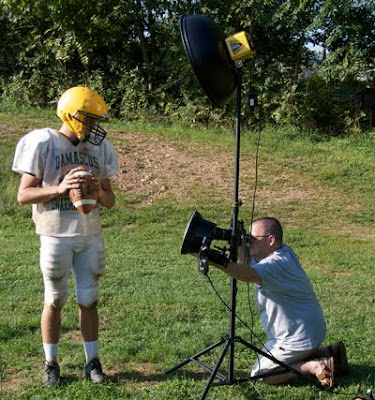
Here is a setup shot, which shows just how contrasty and crappy our straight ambient light was at the time:

That pic (courtesy Dave Kile) does not include the VAL'd SB-800 -- it would be coming from just out of the frame at left.

One thing you can see here is that I have detached the ring light from the camera so I can feather it up quite a bit. This allows me to keep the bottom of the frame, which is much closer to the ring light, from getting too hot. Actually I feathered it a lot higher than in this photo. But you can see the disconnect from the lens axis and the light axis, which is what is important.


Portrait and a Headshot

The job called for a single portrait with a little space in it. But I always include a tight headshot, for several reasons.

Number one, headshots get re-used -- a lot. That was something I learned freelancing back in college when every penny counted: Always make a habit of including an extra headshot. Do it often enough and you will be rewarded by little surprise re-use checks for years to come. They are never big, but then, it's found money.

Plus, a headshot, lit well, can also morph into a cover if need be. And those checks are bigger.

The sun was getting a little lower so that gave us some options. We scrounged a shipping container (naturally, on a football field, right?) as a shade/sun background and went to work there.

I say shade/sun because the container was in shade but the area in front of it was getting sun rim light. That's gonna make this headshot easy-peasy-lemon-squeezy, as the gecko says.

The whole thing is built on that ambient rim light. We put it over his camera-left shoulder and dropped down the ambient exposure until the color was rich and the rim lit area was just losing detail.

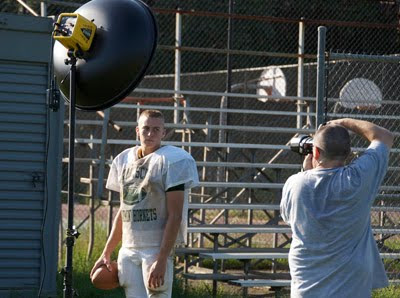
Here's the setup:

In the past, I generally would have the key light and the rim light coming from opposite directions. But lately I prefer to key and rim from the same side if I have detail and separation on the shadow side. Just makes for a cooler looking wrap, I think.

So we brought the beauty dish in from upper camera front left and cranked it up until his face looked good. Notice -- no flash meter. Again, it's just an add-salt-to-taste progression that goes very quickly and leaves you the natural option of doing something other than the "perfect" flash exposure.

I used to obsess about perfect. Metered to a tenth of an f/stop. (Screw The Force, Luke. Trust your Meter.)

Now, I could give a rat's butt about "perfect," preferring to go with what I think, looks best. It's the relationship between the different light levels that matters, anyway. And if you always go for perfect exposure values (as conferred upon you by your Almighty Flash Meter) your photos start to look a lot alike.

That's another reason to embrace a little randomness, IMO. Make mine al dente, please.


Here's the final. It's a quickie headshot that will look fine as an inset mug, but could do more if asked. And who knows? Connor might go on to be a hotshot NFL QB. So a badass-looking high school headshot might be a good thing to have in ten years.

(We did a looser version, too, but I prefer the headshot.)

Is it a "perfect" exposure as defined by a flashmeter? No clue.

But I like it, and I am a Committee of One where exposure is concerned. (It passed, unanimously.)


Football Football Football Football Football

Now that I am no longer spending my fall Saturdays away from the family shooting college football for the paper, I have had the chance to go from being a mere Florida Gator fan (my alma mater) to being a crazy, raging, full-on brainwash-your-kids Florida Gator fan.

But long before I went to the University of Florida, I was an University of Alabama fan. Way back in the days of Major Ogilvie, I wore Crimson and yelled "Roll, Tide!" from first snap to final whistle. And during the years I shot for the paper at UF, road trips to 'Bama were my favorite away games to shoot. Great teams, great fans and great parties afterward.

On Saturday, my two favorite teams, both undefeated and now ranked #1 and #2, will play each other in the SEC championship game. The winner will go on to play for the national championship in January.

I will admit to being a little conflicted. But not much.

On Sunday I will go back to being a fan of both teams. But until then, Go Gators. Beat Alabama.
__________


Next: Shooting for Social Media

An Exercise in Seeing Light

This time of year, I usually take a moment to point to an archive post from 2006 on how to photograph holiday lights.

It is a fun (and festive) exercise in getting a feel for how your camera sees relative light levels differently than you do.

In addition to being a good excuse to spend a little quality time with your family, the improved understanding will help you better understand ratios and light levels for your own lit photos.

-30-

Wednesday, December 2, 2009

First Look: Pixel TR-331 TTL Remote Nikon Triggers

UPDATE #1: Full manual has been uploaded (as a .jpg) here. Off-camera TTL flash is easy to figure out and works pretty well. But iTTL (i.e., master/slave TTL multiflash) continues to elude me.

UPDATE #2: We have our beta tester. Please, no more volunteers...

Just got in an early set of Pixel TR-331 (Nikon compatible) TTL remote triggers. First look, and a call for local Baltimore/Washingon TTL Nikon shooters who might want to give them a test drive this weekend, inside.
________


First Impressions

Right off the bat, they look a couple of notches above the typical "eBay" remotes in build quality. These guys are tight, and built solid.

All TTL connections are hot-shoe based and very solid. There are screw locks and locking pins. Your flashes will be secure.

Right now they only have Nikon models, but Canon are supposedly coming early next year.

They are essentially a wireless TTL bridge, supporting TTL flash and high-speed FP sync. They can also be used in manual mode as dumb triggers. You can use manual mode in FP sync, too.

Quick testing showed them to be pretty reliable. Not rock solid, but neither did they miss very often. I'd put it in high 90's for normal working distances.

I have one transmitter and two receivers, and found I could vary the TTL output level at the physical setting on the flash itself to easily create ratios between the two flashes.

TTL results looked to be just fine, although I am not generally a TTL shooter so I do not know whether the remotes or the internal camera TTL systems get credit for any exposure variances.

I tested it in FP mode and got reliable sync speeds right up to 1/8000th of a sec. Because of the way FP sync works (using pulses) the power levels of the flash were predictably lessened as you walked up the shutter speed scale.


High marks for the supplied sync cord choices. You get two screw-lock PC-based cords which will connect the remotes (in dumb sync mode) to any flash which syncs off of a 1/4" or 1/8" jack.

Frequency on the unit is 2.4Ghz, which means it'll be cool to use anywhere in the world with regard to various countries' radio frequency allocations. But you will also be competing with the likes of cordless phones, wi-fi and microwave ovens. FWIW, I was testing these indoors about 15 feet from a wireless router and getting good sync percentages, tho.

Biggest irk, given that I have not yet been able to test them thoroughly, is that they run on (for me) hard to find CR2 batts. These are sub-sized and 3v.

I spent two hours hitting two Targets and a Wal-Mart with no luck. Finally just had some shipped from Amazon. Pain in the butt. I sure do wish they would sacrifice a little form factor and go AA's. You get way more battery life and universal sourcing on the batts.

Lastly, the instruction manual is predictably funny and confusing -- and replete with (presumably machine) translation hiccups. Actual line in the manual:


"This is electronic products accessories, some of the environment causes may affect the working. However, this is hardly ever to get this situation. Don't Worry!"

Okay! I won't!


Calling Local Beta Testers

[UPDATE: We have our local beta testers all lined up -- to professional shooters in NoVA who use Nikon TTL frequently enough to eval them way better than I could. Thanks to those who volunteered! -DH ]

If you are local to Baltimore/Washington and would like to give them a full test drive, I would be happy to lend them out for a few days. I am booked solid well into next week and will not be able to give them the testing they deserve in a timely manner.

Here is the deal:

1) You should shoot Nikon, and be familiar with Nikon TTL flash. One of my weaknesses in testing these is that I I do not know if any inconsistencies are coming from the remotes, the camera, the flashes or the idiot pushing the button. I am a manual guy. You should be familiar with Nikon's TTL results.

2) You should be willing to pick them up and drop them off in Ellicott City and prepared to shoot over the weekend.

3) You should be willing to supply pics and your impressions of the units' performance.

4) Preference will be given to more than one person who may wish to work together, for diversity of opinion. So if you normally hang with a local meetup group or a shooting buddy, that would be ideal.


For time purposes, I can only choose one beta tester, and will pick from volunteers based on the above criteria by midday Thursday. If interested, please mark your comment as "Do Not Publish" and leave email and phone number as contact. I will update this post after I choose someone. (Got 'em. -DH)

Of course, I will relay the shooter(s)' pics and findings in a future post.


Obligatory Lighting Geek Stuff

Thought some of you might be interested in the makeshift printer paper studio I just used to shoot theses.

Everything is on manual, mostly around 1/64th power. I tripped them with low-power, onboard flash on the Canon G11 point-and-shoot I used to shoot the pics.

If you need to shoot something small quickly, printer paper and small flashes are your friends.